FIRST GRADE: BEAT AND RHYTHM (I)
One of our main learning goals for G1 is to provide students
with experiences from which they can gain understanding of two fundamental
elements of music: beat and rhythm. The ability to internalize musical knowledge and reach understanding depends on direct experience. Students engaged in very diverse activities with the purpose of developing kinaesthetic, aural and visual awareness of beat and rhythm and then to proceed to their symbolic representation
using music notation.
To illustrate this sequential process of building understanding, I have chosen as an example the rhyme Engine Engine Number Nine that students had previously learnt. These were some of the steps of their learning process.
-We initiated our inquiry about the concepts of
beat and rhythm with two key questions that lead the children's attention to their
bodies as the first source of rhythmic experience: how can we show the beat with our bodies? and how can we show the rhythm in our bodies?
Kinaesthetic awareness
Moving to the beat:
- Chanting Engine Engine, the students lined up like
a train and marched to the beat. The students adjusted their locomotor response to the beat . As the train passed through a tunnel, the students
sang softer, as the train was travelling through a bumpy area, the students sang using staccato or legato, or fast or slow as the train was climbing or going down
a mountain. In this way the students were incorporating other musical elements related
to dynamics, tempo, and articulation.
Kinaesthetic awareness
The rhythm in the body:
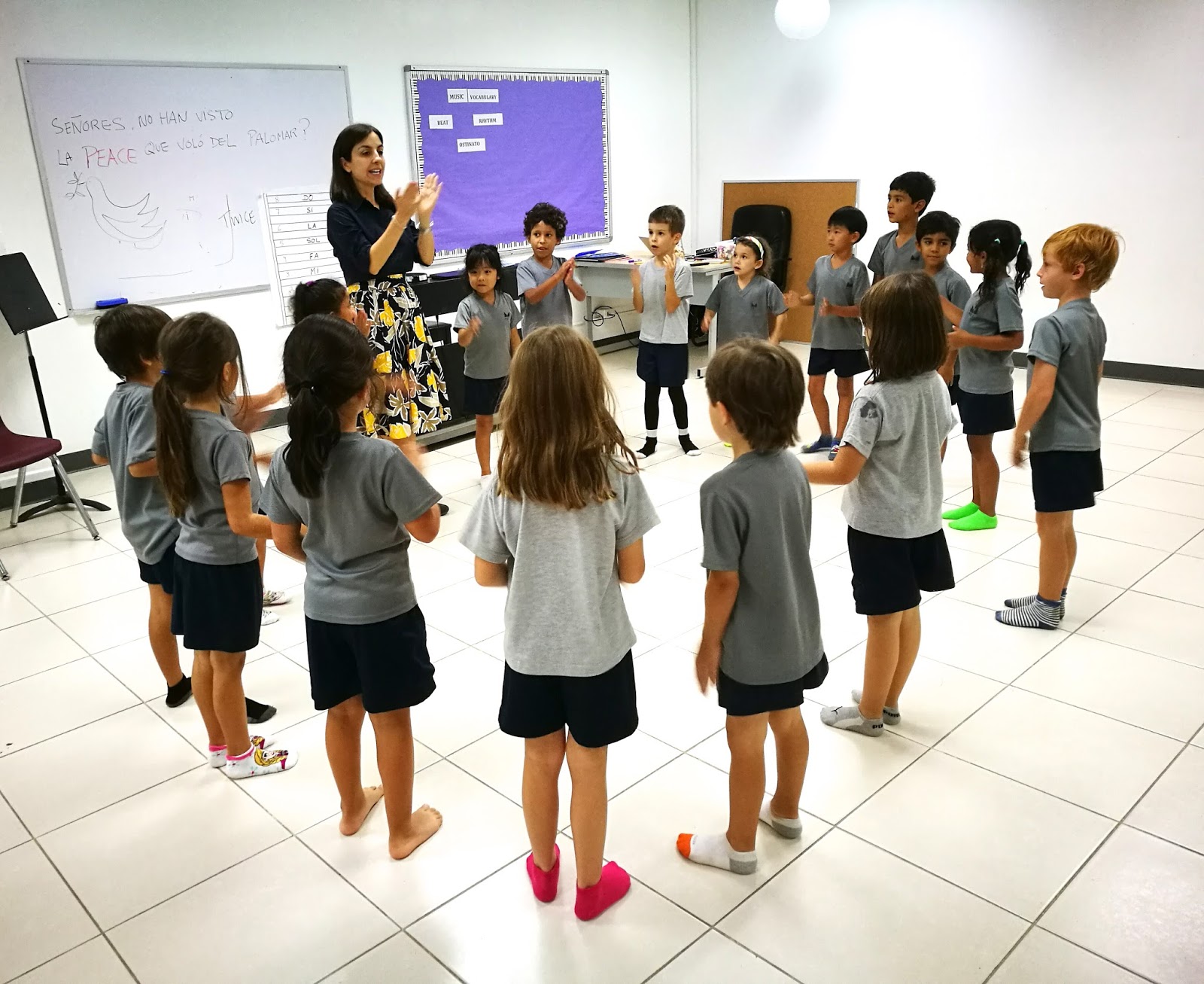
- The students also participated in diverse body percussion experiences, clapping, stamping, chest/leg patting or snapping to the rhythm of Engine Engine.
Aural awareness
Rhythm in speech:
In our inquiry, we define the rhythm as ¨as the words go¨. Our point of departure are familiar speech patterns, such as students’ names. We organized the students in groups of four and chanted the rhythmic patterns resulting from their names. Then we played around with the patterns by reorganizing the groups of students.
Aural awareness
Transferring to instruments:
As a next step, the rhythm that we experienced in what is nearest to us, our own body and speech, was transferred to percussion instruments. The students performed the beat and different rhythmic patters using Orff instruments (xylophones, metallophones and glockenspiels).
Visual awareness
Iconic Representation:
The students, with the help of the teacher, analyzed aurally the characteristics of the rhythmic element, verbalizing what they perceived. This preparation was still done in the context of Engine Engine Number Nine. We began with iconic representation of the rhyme.
We projected the following two images on the wall to help the students create a visual connection between the rhyme and a graphical representation of its beat and rhythm.
Visual awareness
Traditional music notation: from sound to symbol
Then the students, with the teacher’s assistance, transfer the iconic representation of the rhythm to conventional music notation. At this stage the students learn the conventional symbols for quarter notes, eighth notes and rests in the context of a musical piece (in this case, Engine Engine) that they have experienced in many different ways.
FIRST GRADE
BEAT AND RHYTHM (II): RHYTHMIC NOTATION
First Graders learned how to perform and read music notation using quarter notes, eighth notes and rests.
First Graders used manipulatives to represent the rhythm songs or rhymes they already knew. They also created their own four beat patterns and write rhythms by dictation.